Fluid Heat Transfer Coils
Air Conditioning • Heating • Refrigeration



Refrigerant Heat Exchangers
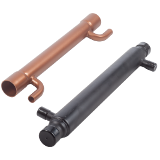
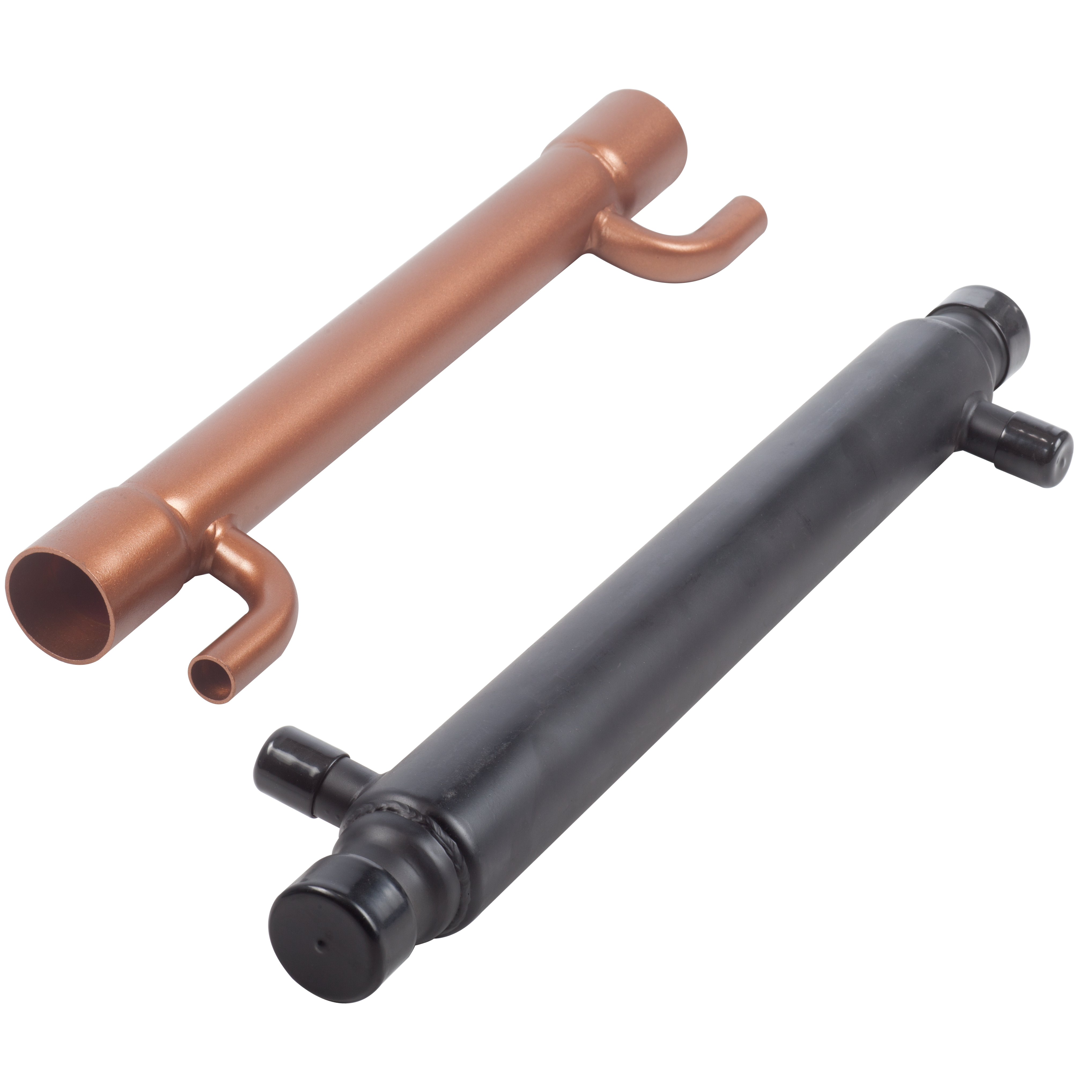
Packless Turbo Heat Exchangers are specifically intended for application on refrigeration systems to transfer heat between liquid refrigerant leaving the condenser on the high pressure side of the system and refrigerant vapor leaving the evaporator on the low pressure side of the system. All HXR models are UL listed and all LHXR models are UL recognized.
Packless refrigerant heat exchangers are compatible with all A1, A2L, and A3 refrigerants which includes CFC, HCFC, HFO, HC, and HFC refrigerants.
The Packless refrigerant heat exchanger provides many benefits including:
- Evaporating any excess liquid in the suction line before it enters the compressor
- Subcooling any excess vapor in the liquid line before it enters the TXV
- Increased vapor temperature to prevent frost on the suction line
- Providing a small increase to system refrigerating capacity
Available Models
More Details
Packless Turbo Heat Exchangers utilize a coaxial "tube-in-tube" design. Refrigerant vapor flows through the inner tube while refrigerant liquid flows in the annulus between the inner and outer tubes.
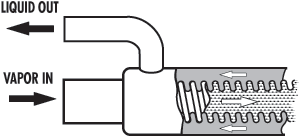
The key to the high performance of Packless refrigerant heat exchangers is the convoluted multi-lead inner tube manufactured in a patented process. The resulting convoluted tube has increased heat transfer surface area per unit length still permits full flow of refrigerant around its entire periphery for improved performance.
Turbulence imparted by the convolutions to the refrigerant flows further enhances the thermal performance with the net result being an effective, compact heat exchanger. Optimum heat transfer with Packless Turbo Heat Exchangers is achieved using a counterflow arrangement, with the refrigerant vapor flowing through the center and the refrigerant liquid flowing within the annulus.
Each unit is furnished with ID sweat connections on both the vapor and liquid sides. Standard sizes are recognized or listed by Underwriter's Laboratories, Inc. (C-UL).
Packless heat exchangers can be ordered with custom fittings and customized designs to meet the requirements of your project. Tell us what you need and our engineers will assist in making it happen.
Selection Procedures
Refrigerant heat exchanger selection is predominantly dependent on nominal system horsepower. The HXR and LHXR models are rated for 10 °F liquid subcooling and 20 °F suction gas superheat for R-22 and R-502 systems. At this rating point the system is operating at 110 °F condensing temperature. For example one could use an HXR-250A for a nominal 5 hp system.
One should exercise caution to avoid selecting an undersized model. The use of an undersized model can cause system operation problems such as gas whistling and high suction side pressure drop. This may also have adverse effects on overall system performance.
In some applications, the refrigerant heat exchanger may be intentionally over-sized to attain additional liquid subcooling and suction gas superheat. This is acceptable provided the return gas temperature is less than 65 °F.
Selecting a refrigerant heat exchanger by matching the system suction and liquid line sizes with the connection sizes of the heat exchanger should only be done when the nominal system horsepower rating closely matches that of the system.